The Company has designated the Sustainable Development Committee, which operates the Board of Directors, as the dedicated unit for promoting ethical management. The committee reports to the Board of Directors at least once a year. The It assists in integrating integrity and ethical values into the Company's business strategies, and, in line with legal requirements, formulates preventive measures to ensure ethical management. It is also responsible for establishing ethical management policies, supervising their implementation, promoting and coordinating related trainings, planning the whistleblowing system, and ensuring its effectiveness.
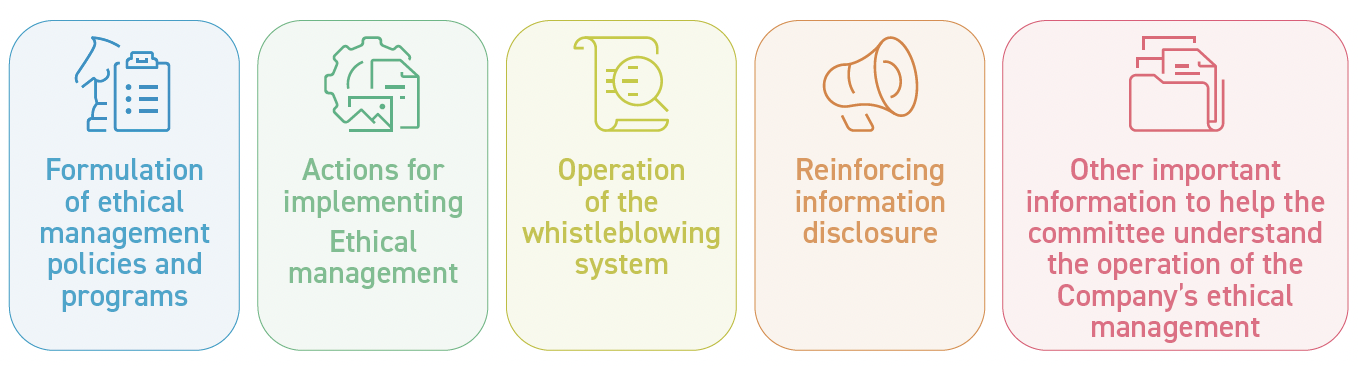
The Company reports to the Sustainable Development Committee at least once a year on the implementation status of ethical management, measures taken, and the results of investigations into whistleblowing cases. In 2025, it reported twice in March and September. The reports covered 5 aspects: the formulation of ethical management policies and programs, actions taken to implement ethical management, (including education and training); the operation of the whistleblowing system; enhanced information disclosure; and other important information that helps the Committee understand the operation of the Company's ethical management.
The Company has established effective accounting and internal control systems for business activities with a higher risks of unethical conduct, and continues to review and refine these systems to ensure the effectiveness of their design and implementation. The Auditing Department includes compliance with these systems within its audit scope and prepares audit reports accordingly. The status of corrective actions for identified deficiencies is periodically reported to the Audit Committee and the Board of Directors. Additionally, the Company conducts legal compliance self-assessment on a semi-annual basis. These assessments cover relevant regulations, including the Financial Holding Company Act, Company Act, Securities and Exchange Act, Money Laundering Control Act, Counter-Terrorism Financing Act, with reference to the Anti-Corruption Act, to ensure business operations are aligned with the Company's integrity policies.
Furthermore, each year, the Company compiles and submits reports to the Sustainability Development Committee and the Board of Directors reports on high-risk business activities with potential for unethical behavior identified by each subsidiary within its operational scope, along with the corresponding preventive measures. In 2025, all domestic and overseas operating sites of TCFHC Group conducted corruption risk assessments, achieving a 100% coverage rate. According to TCB's 2025 unethical conduct risk assessment report, no regulatory penalties or deficiencies identified through internal or external audits were found in relation to existing corruption risk scenarios. The effectiveness of the control measures was assessed as high, and no significant corruption risks were identified.
Implementing Ethical Management
In order to effectively promote ethical management ,the Company has established "Ethical Corporate Management Best Practice Principles" and the "Procedures for Ethical Management and Guidelines for Conduct" in line with regulations governing business conduct, including the "Financial Holding Company Act", "Company Act", "Securities and Exchange Act", "Business Entity Accounting Act", and "Ethical Corporate Management Best Practice Principles for TWSE/TPEx Listed Companies", with reference to the "Anti-Corruption Act", "Government Procurement Act", and "Act on Recusal of Public Servants Due to Conflicts of Interest" . These policies govern the prohibition of providing or accepting improper benefits, political contributions, donations or sponsorship, anti-corruption and bribery measures, prohibition of insider trading and confidentiality agreements, avoidance of conflicting interests, avoidance of transactions with unethical parties, ethical business activities, prohibition of unfair competitive practices, handling and internal promotion of reports on unethical conduct, establishment of reward and punishment systems, complaint mechanisms and disciplinary actions, and the integration of ethical management policies into employee performance evaluations. In addition, the Company has established the "Employee Service and Code of Conduct Guidelines", "Measures for Whistleblowing" , and "Guidelines for Handling Whistleblowing Cases" , and has clearly stated its ethical management-related regulations and practices on its official website, in annual reports, and in external documents to promote ethical conduct and prevent unethical behavior.
The Company has formulated regulations such as the "Human Rights Policy" and the "Employee Service and Code of Conduct Guidelines" applicable to all employees. If any member of management or employee violates the code of conduct, the Company will submit the matter to the Review and Evaluation Committee in accordance with the "Employee Rewards and Discipline Guidelines" and the "Employee Performance Evaluation Guidelines". The severity of theviolation will be considered to determine thecorresponding disciplinary action and the gradefor the year-end performance evaluation. This will also affect the amount of the employee's annual compensation. For severe violations, the employment contract will be terminated in accordance with relevant regulations to ensure effective implementation of the internal code of conduct.
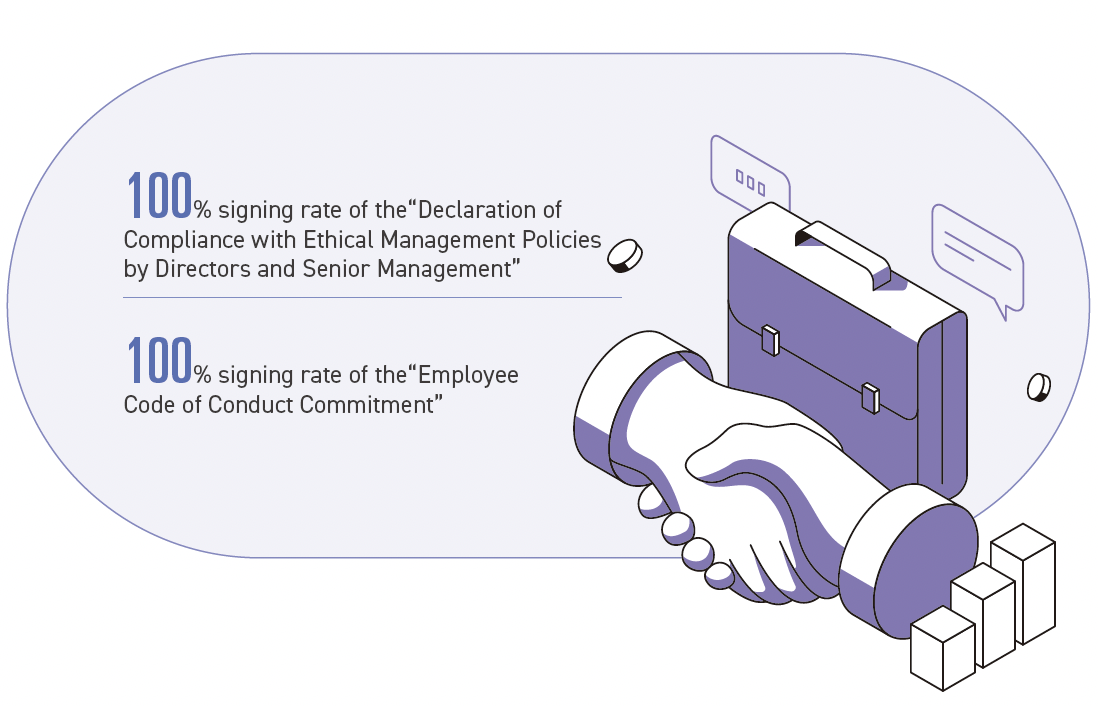
To fulfill its commitment to ethical management, the Company has established the "Declaration of Compliance with Ethical Management Policies by Directors and Senior Management". In 2025, a total of 112 directors and senior management personnel of the Company and its subsidiaries all signed the declaration. Furthermore, 100% of the employees of the Company and TCB have signed the "Employee Code of Conduct Commitment". All subsidiaries within the Group report the status of compliance with the Ethical Corporate Management Best Practice Principles to their respective Boards of Directors every year,and all such reports were completed in 2025. Before establishing business relationships with external partners, the Company must conduct ethical management assessment to avoid transactions with dishonest parties, and incorporates its ethical management principles into contract terms in order to put its ethical management principles into practice.
In 2025, TCFHC Group had no incidents involving corruption, fraud, bribery, insider trading, money laundering, anti-competitive behavior, antitrust or monopoly practices, market manipulation, improper political contributions, or improper charitable donations and sponsorships in violation of its code of conduct. However, 1 conflict of interest case occurred. The case involved a former teller of TCB who misappropriated customer payments by delaying the posting of tax and fee payments, for which the FSC imposed a fine of NTD 2 million. In addition, 1 customer privacy incident occurred, involving an operational error by an outsourced vendor of BNP TCB Life, which resulted in 2 insurance policies being mailed incorrectly and affected 2 customers. There was also 1 other unethical conduct case. During a special inspection of TCB's insurance agency business, the FSC identified deficiencies in the management of wealth management seminars, including the inappropriate promotion of specific financial products, and imposed a fine of NTD 800,000 based on inspection findings. For other cases involving regulatory penalties due to violations of business regulations and related corrective actions, please refer to Section Legal Compliance, Anti-Money Laundering and Combating the Financing of Terrorism .
Ethical Management Educational Training
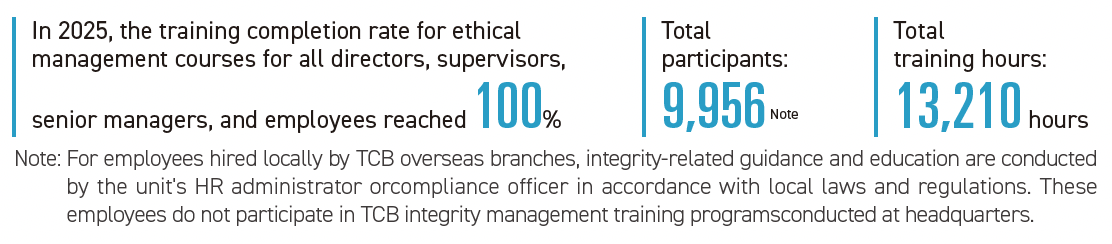
The Group continues to offer annual educational training courses related to ethical management (including topics on anti-corruption and anti-bribery). In addition to developing online courses for all employees, external lecturers are invited each year to deliver specialized seminars on ethical management topics. Participants include directors, senior management, and managers of all Group companies, aiming to convey the importance of ethical management to all employees through a top-down approach. In 2025, an external speaker was invited to give an in-depth analysis on the topic of "Ethical Management and Conduct Risk".The seminars introduced international anti-bribery and anti-corruption regulations and trends, examined the challenges faced by Taiwan's financial industry in recent years, and discussed ways to further strengthen the culture and training framework for ethical management in the future. In response to evolving trends and regulatory changes, the seminars also introduced accountability systems and accountability framework, highlighting 3 key actions for implementing accountability framework and demonstrating the Group's commitment to fostering a culture of ethical management through concrete actions.
Whistleblowing System
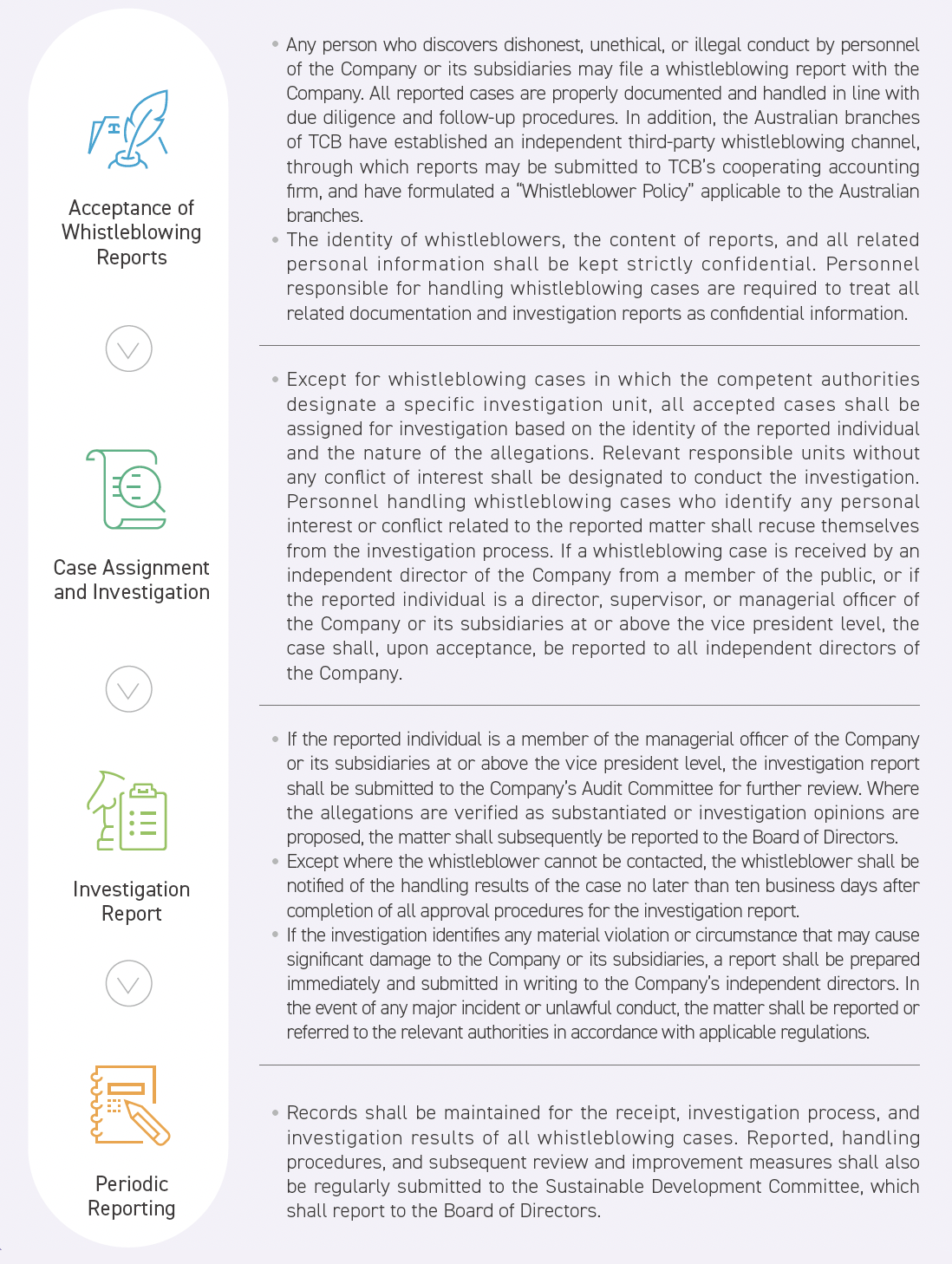
Whistleblowing System Operation Mechanism
To prevent illegal activities, promote sound corporate operations, and protect whistleblowers, the Company has established the "Measures for Whistleblowing" and the "Guidelines for Handling Whistleblowing Cases". Annual online training on the whistleblowing system is conducted to help all employees understand and become familiar with the Company's whistleblowing regulations, reporting channels, and available protections, thereby ensuring the effective implementation of the whistleblowing system.
The Company may not dismiss, remove, demote, reduce the salary of, or otherwise subject the whistleblower to any unfavorable treatment due to a whistleblowing case, nor may it impair any rights or interests to which the whistleblower is entitled to by law, contract, or customary practices.
Where a reported case is verified as substantiated, the Company or its subsidiaries shall impose disciplinary actions on the reported individual(s) and other personnel involved in accordance with the relevant disciplinary regulations. In addition, the whistleblower may be granted an appropriate reward depending on the severity of the reported matter. Any internal personnel found to have made false reports or malicious accusations shall also be subject to disciplinary actions, with the aim of strengthening a corporate culture founded on integrity and transparency.
Status of Handling Whistleblowing Cases in 2025
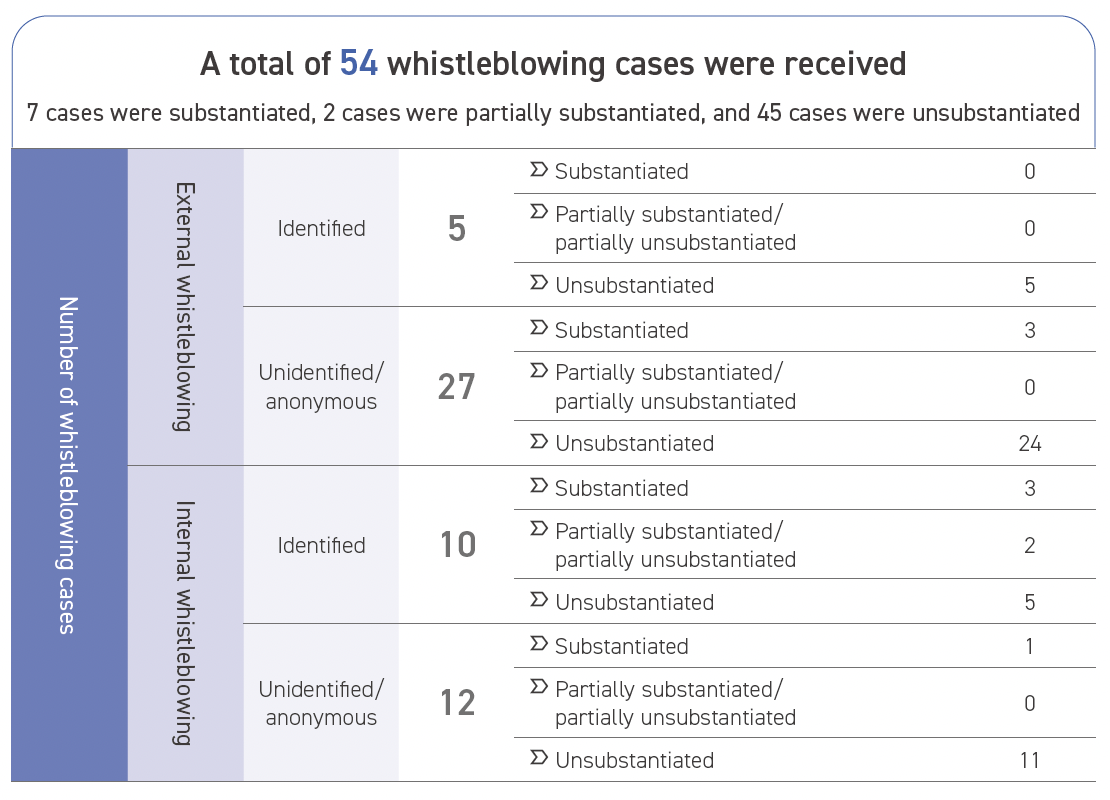
In 2025, the Group did not engage in any act that infringed upon the rights and interests of whistleblowers or adverse treatment. A total of 54 cases were received through the Group's whistleblowing mailbox in 2025, all of which have been investigated and closed with reports completed. Among these, 7 cases were substantiated, 2 cases were partially substantiated, and 45 cases were unsubstantiated. The investigation results of the whistleblowing cases for the first half of 2025 were submitted to the Sustainable Development Committee in accordance with regulations on September 10, 2025. The investigation results of the whistleblowing cases for the second half of 2025 were submitted to the Sustainable Management Committee on March 3, 2026.