
Amid the rapid growth of the digital economy, financial products have become increasingly diverse and complex. Meanwhile, Internet entrepreneurs and technology companies have also entered the digital finance sector, bringing both opportunities and challenges. The Group places great importance on user experience. To develop more user-friendly financial products, enhance service efficiency, accessibility, usability, and quality, and build professional financial services that are not constrained by time and location, the Group not only leverages digital technology capabilities but also integrates business innovation to help customers stay informed of their account activities and fund movements at any time, thereby maximizing the benefits of digital financial services.
Innovative Digital Financial Products and Services
The Group actively promotes innovative digital finance. By using data-driven decision-making to optimize the customer experience, and through big data analytics, robotic process automation (RPA), customer feedback, AI technologies, and integrated automated process, the Group provides comprehensive digital financial services and brings financial products and services closer to everyday life.


Innovative Patent R&D and Management
TCFHC formulated its "Intellectual Property Management Program" to promote the integration and coordination of intellectual property management jointly with its subsidiaries. TCB introduced the "Taiwan Intellectual Property Management System" (TIPS) for the first time that year to enhance its management of intellectual property by adopting the "Plan-Do-Check-Act (PDCA)" cycle, and became the first state-owned bank in the country having to be certified as TIPS Class A 3 times, demonstrating outstanding results in creating and protecting intellectual property.
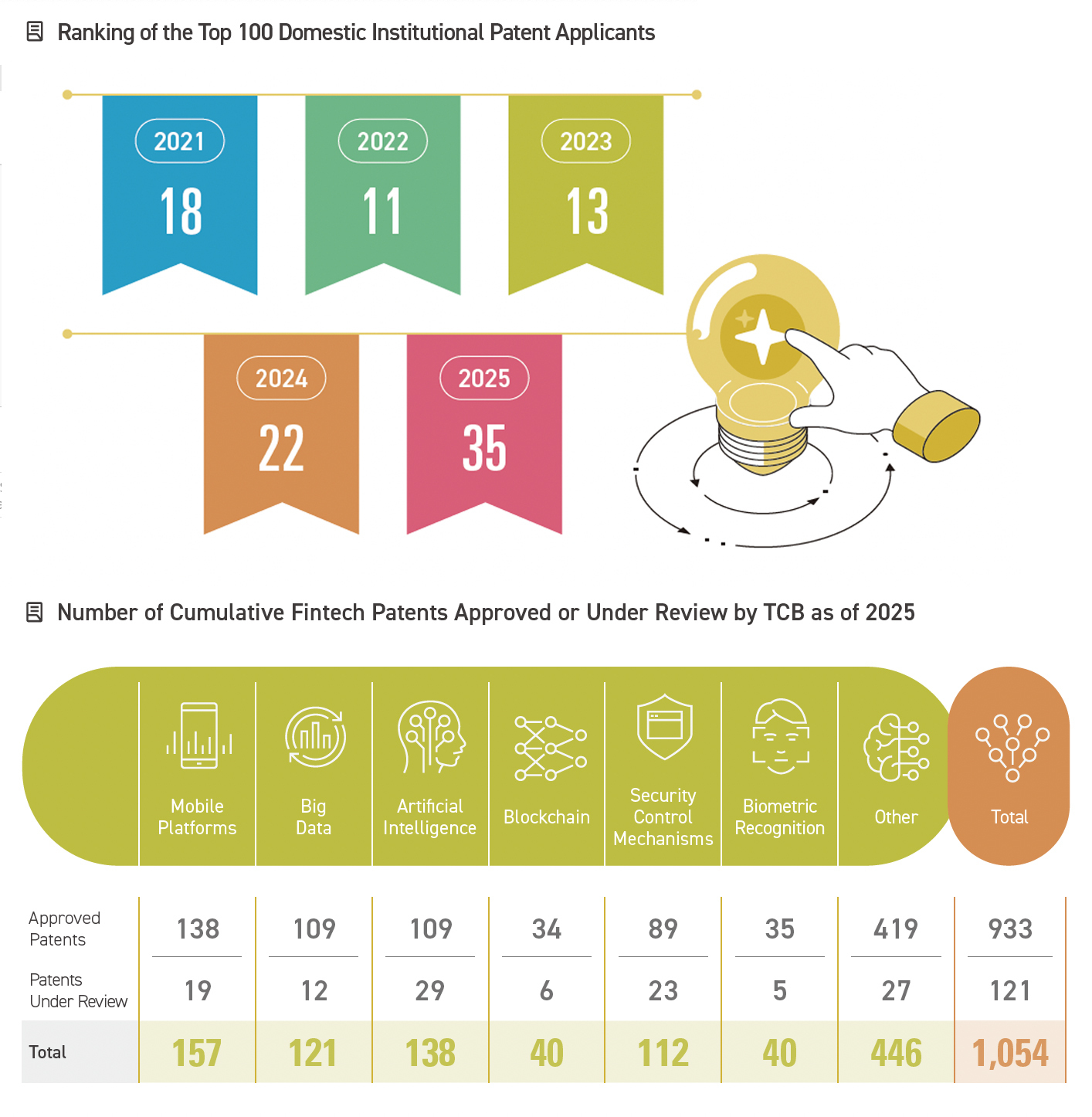
TCB continues to hold intellectual property-related cognitive education and training courses each year to enhance employees' awareness of and appreciation for intellectual property, and to strengthen risk management and internal controls to ensure security and legitimate use. Meanwhile, a patent incentive system is in place to encourage proactive research and development of innovative technologies among employees. As of 2025, more than 933 patent certificates had been issued by the Intellectual Property Office, Ministry of Economic Affairs, and had been actually applied in areas such as credit and loans, debt management, foreign exchange, business and marketing, anti-money laundering, and electronic finance, leading to improved operational efficiency and reduced operational risk.
Since 2018, TBC has ranked among the top 100 domestic institutional patent applicants for 8 consecutive years. In 2025 alone, it filed 100 patent applications covering various areas such as big data, mobile platforms, AI, and security control mechanisms, demonstrating its commitment to developing innovative applications across all business areas.
Creating a Culture of Innovation – CoLAB
To maintain the momentum of driving innovation and developing innovative managerial capabilities, and to achieve the long-term goal of forming a culture where innovations are shared and sustained, TCB established its collaborative innovation lab (CoLAB) in 2019 to help nurture seed staff. A cross-departmental collaborative and innovative business model was created to facilitate ongoing collaboration with external consultants and the sharing and exchange of business experience among various internal and external teams, in order to generate creative output and maximize potential financial applications that address market trends and business needs.
Innovative Value and Culture
CoLAB has transformed the corporate philosophy of "Proactive, Agile, Innovative" into its core competencies and established operational modules that drive digital innovation and transformation, continuously promoting the growth of digital innovation.

Innovation Benefits and Maintenance
In accordance with the AI strategy blueprint, in 2025 the Group continued to integrate AI application scenarios with business opportunities to support the promotion and execution major digital transformation projects, as well as small-scale validation of the commercial viability of innovative solutions. At present, one AI action plan, credit knowledge management, is being promoted. CoLAB assisted the Digital Development Committee in promoting 21 digital operation projects covering corporate banking, personal banking, and technology infrastructure, together with the implemention of the "Digital Customer Experience Guide", in order to accelerate the enhancement of customerdigital experiences.
FinTech and Artificial Intelligence
Artificial Intelligence Policy
In response to the rapid development of AI technology and its potential impact on operations, customer rights and society, the Group has established an "Basic Policy on the Use of Artificial Intelligence" as the governing principle for the introduction and use of AI-related technologies. The Group complies with applicable regulations concernin information and communication security, intellectual property, and trade secrets to ensure the robustness and security of AI-enabled systems, fully respect and protect customer privacy, and incorporate ESG performance into supplier selection criteria, thereby ensuring the deep integration of technological innovation and sustainable development.
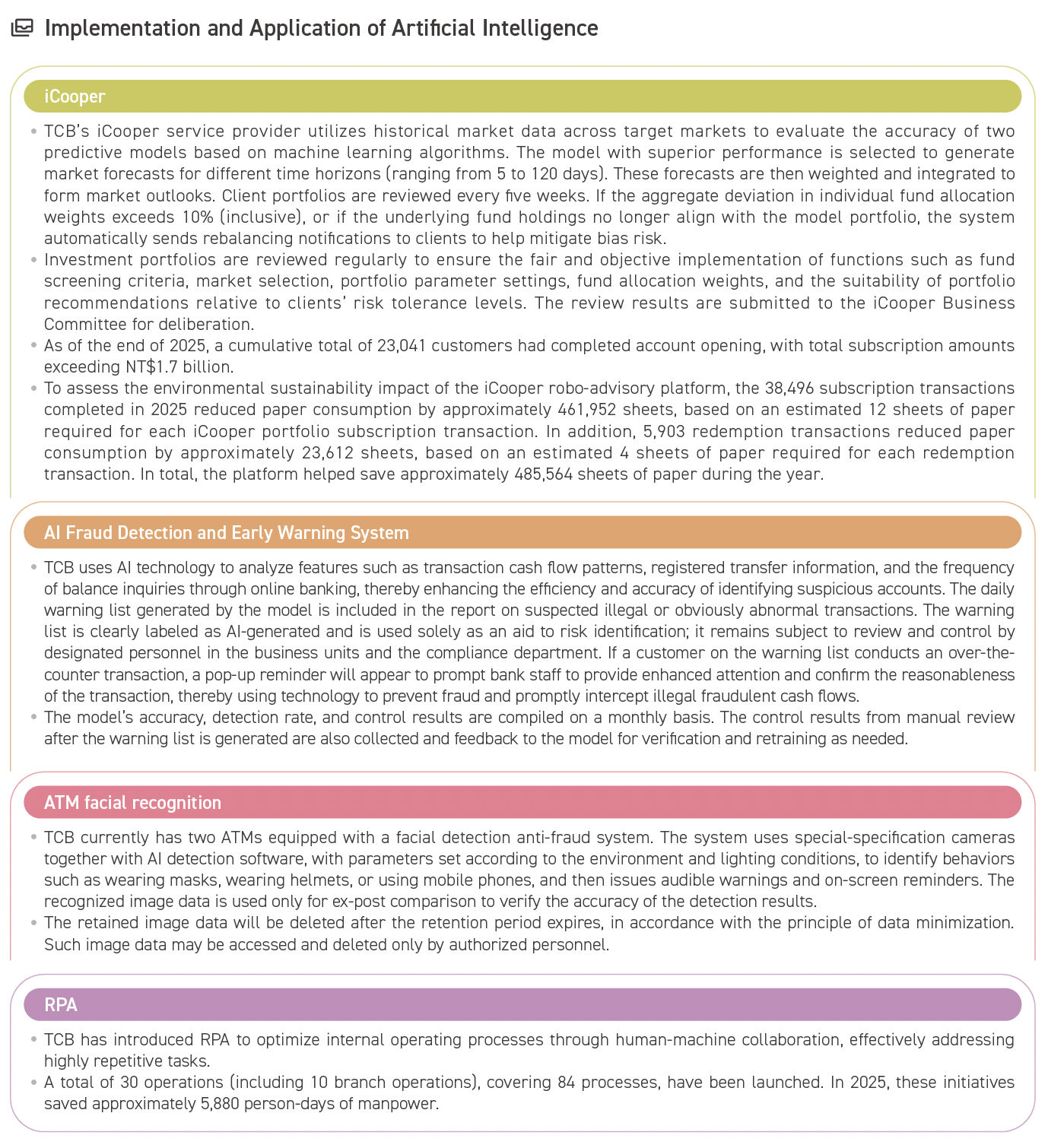
FinTech and AI Management Mechanism and Fulfillment of Sustainability
The Group values customer feedback on its various services. If customers have any questions or suggestions regarding AI-related services, they may submit their comments through the opinion mailbox on the official website.
In addition, to enhance employees' awareness of AI, TCB held "AI Governance Education and Training" in 2025. Participants included senior executives and employees at the head office and branches. The training covered international and domestic trends in AI governance, key areas of concern, and control principles, with the aim of strengthening employees' awareness of AI governance risks. TCBF and TCVC also arranged for employees to attend external training courses, such as "Information Security Trends in the AI Era", "AI-Based Cybersecurity Protection Thinking", and "Practical Applications of ChatGPT and Image Generation", to help employees gain practical knowledge, strengthen AI-related information security protection capabilities, and enhance the overall level of information security.
In view of the energy consumption that may arise from data centers and model operations, the Group has actively improved the efficiency of AI project models to effectively reduce energy use. After optimization, execution time was reduced from 10 hours to only 1 hour per run, resulting in annual electricity savings of 64.8 kWh. In addition, ESG-related energy-saving and water-saving projects have been carried out in the data center building, including the installation of intelligent power distribution cabinets and office electricity meters, replacement of battery packs and capacitors in the uninterruptible power supply system, replacement of office air-handling units, installation of total heat exchangers, and energy-saving improvements to data center lighting together with soundproofing works. The Group also continues to maintain the validity of ESG-related ISO environmental certifications, including ISO 14001 Environmental Management System, ISO 50001 Energy Management System, ISO 14064 Greenhouse Gas Inventory, and ISO 46001 Water Efficiency Management System, in order to reduce the energy consumption and environmental impact associated with AI data centers and model operations.
The Group places great importance on the governance and application management of artificial intelligence and continues to strengthen the relevant policies and management mechanisms. To reinforce the foundation of AI management and enhance the credibility of information disclosure, the Group commissioned BSI to conduct a Mark of trust AI Foundation Framework verification, serving as an important basis for reviewing and advancing its AI governance practices.