
According to the World Economic Forum (WEF) Global Risks Report 2026, nature-related issues such as "biodiversity loss and ecosystem collapse", "critical change to Earth systems", and "natural resource shortages" rank, respectively, 2 nd , 3 rd , and 6 th among the Top 10 global risks in the coming 10 years, indicating that the overall nature risk is gaining prominence besides climate risk. As part of its risk-oriented management awareness, the Group is gradually including nature-related risks in its scope of risk management.
Commitment to Biodiversity
The protection of biodiversity helps further mitigate and adapt to climate change and renders a positive influence on agricultural development, food security, public health, and economic sustainability. As such, the Group honors the essence of the United Nations Convention on Biological Diversity by making the following commitments in its Environmental Sustainability and Energy Resources Policy and Code of Practice for Sustainable Development, in hopes of realizing the biodiversity conservation and sustainable use, Corresponding to SDGs 6, 12, 13, 14, 15, and 17 of the United Nations.
The commitments made by the Group in its nature and biodiversity-related policies are as follows:

Analysis of Nature Dependencies, Nature Impacts, and Ecologically Sensitive Locations
For the sake of evaluating the dependency of its own operations and investment and financing portfolio on natural capital and their impacts, the Group adopts the following procedure:
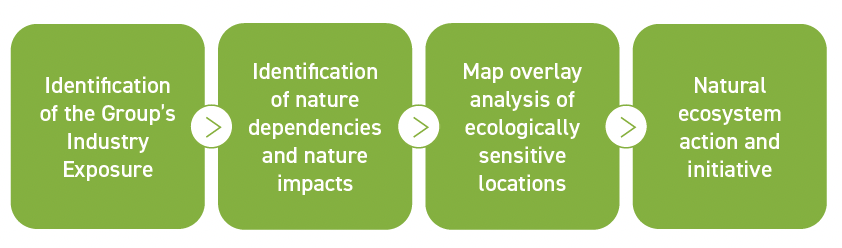
For the current analysis, biodiversity hotspot maps from the Forestry and Nature Conservation Administration of the Ministry of Agriculture in Taiwan are used. Based on parameters such as biological distribution data and species distribution models, animal diversity hotspot maps for mammals, birds, amphibians, reptiles, and butterflies are analyzed.
The maps contain hotspots for animal species in forests, open habitats, streams, or wetlands. Hotspots are defined as the area formed by grid cells with the top 5% of species counts and are divided into 5 levels from high to low, with 5 being the highest and 1 being the lowest.
The Group's biodiversity hotspot impact analysis results show that banking operations are not within a radius of 1 kilometer of Level 4 or 5 hotspots and those in Level 1, 2, or 3 hotspots account for 1.10%, 1.47%, and 5.51%, respectively, of all locations; approximately 91.92% of branches are not located in biodiversity hotspots.
The key biodiversity area analysis results for the current year show that banking locations within a radius of 1 kilometer of key biodiversity areas account for 2.21% of all locations and those not in proximity to key biodiversity areas account for 97.79%.

Countermeasure - Natural Ecosystem Education, Action, and Initiative
Conserving biodiversity has become a world trend. TCFHC proactively takes part in nature and biodiversity conservation events. Besides boosting its people's awareness of protecting the natural environment, TCFHC proactively takes part in public and private ecological conservation actions and initiatives and acts spontaneously to help its people, the society, and customers understand the importance of conserving the natural ecosystem and biodiversity. To turn the idea of conservation from an initiative to real action, the Bank has included biodiversity and environmental impact in the decision-making evaluation framework for investment and financing in hopes of mitigating the impacts brought about by the loss of ecological capital on TCFHC's operations and human society. As some of the Group's operating locations and collaterals are in proximity to biodiversity hotspots such as streams and wetlands, the Group prioritizes protection of river banks, wetlands, and marine ecology-related natural capital before gradually reaching out to other issues and initiatives.
AR3T Action Framework for Nature
TCB, having referred to the AR3T Framework, slows down the impact of investment and financing on nature applying the Avoid-Reduce-Restore & Regenerate, and Transform approach and encourages and guides customers through nature-friendly deeds to leverage its financial influence financially.
To encourage customers to value biodiversity, to avoid developments in ecologically protected areas and key flora and fauna habitats, and to stay away from the deforestation risk, TCFHC includes ESG and biodiversity factors in corporate loan review and investment and financing management procedures. During loan evaluation, the Operating Directions of the Equator Principles are followed and biodiversity and climate change are listed as required assessment items for project-based investment and financing. Cases having failed environmental impact assessments are not supported and those listed as high-risk are subject to further due diligence.Furthermore, loan applicants are investigated on whether they have been involved in any pollution source penalties or labor sanctions and considered comprehensively over their efforts in environmental protection, ethical corporate management, and fulfillment of social responsibilities to determine if they comply with the "Taiwan Sustainable Taxonomy" so that clients are guided to prioritize sustainable economic activities, thereby promoting sustainable business development and natural transformation. As far as investment and financing management is concerned, in compliance with the "Operating Guidelines for ESG Risk Assessment on Investment in Securities" and the "Investment and Financing Business Standards of TCFHC and Its Subsidiaries for Coal Phase-Out and Unconventional Oil and Gas Exploration", investment targets are reviewed periodically on a yearly basis over their ESG performance to ensure their engagement. In case of any violation of ESG principles or investment commitment, they shall be advised or guided to seek corrections and be followed up on the implementation status. In case of infeasibility, on the other hand, the specific investment position will be withdrawn. For related industries such as coal-fired power generation, coal mining, coal trading, and unconventional petroleum & gas, if targets of investment and financing do not demonstrate substantial corrective action or present defined transition plans, new loans or an increase in existing positions shall be avoided.
Dependency and Impact Assessment on Investment and Financing Targets
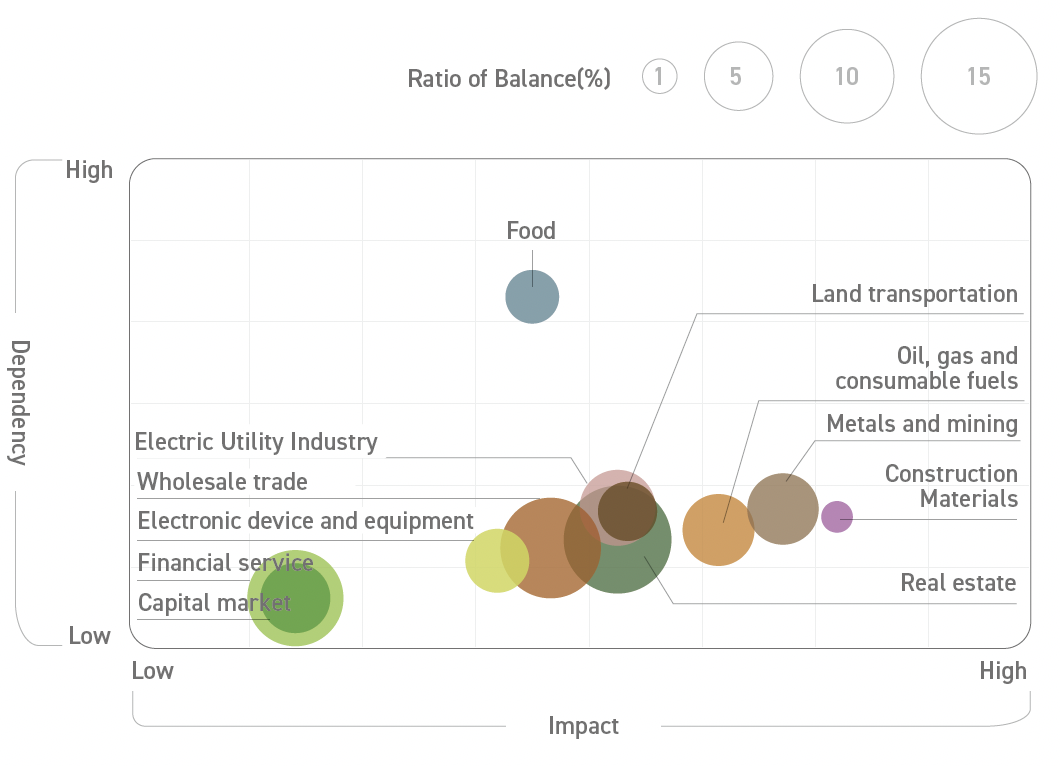
To properly evaluate the dependence on and impacts of the investment and financing portfolio on natural resources, the Group follows TNFD suggestions by applying the ENCORE tool to the analysis and evaluation.
The Group already evaluated investment and financing positions over the respective industries' dependencies and impacts in 2023. Such positions did not show drastic changes in 2024 and 2025. Analysis of the Top 90% industries showed that the food industry had higher nature dependencies, but the risk exposure was relatively low and the nature dependencies of the other industries were also low. Industries with relatively high nature impacts were metals and mining as well as petroleum, natural gas, and consumer fuels. In 2025, the review focuses on industries with relatively high nature dependencies and impacts in the investment and financing portfolio-food, metals and mining, petroleum, natural gas and consumer fuels, electricity utilities, and real estate, which has the highest risk exposure. The dependency and impact factors are analyzed in order to advance in nature risk investment and financing management strategies and the corresponding risk management procedures are defined to hopefully mitigate potential impacts. For complete disclosures, refer to Sections in the 2025 TCFD & TNFD Report .
Management Measures for Nature-related Metrics and Targets
Water Resources Metrics
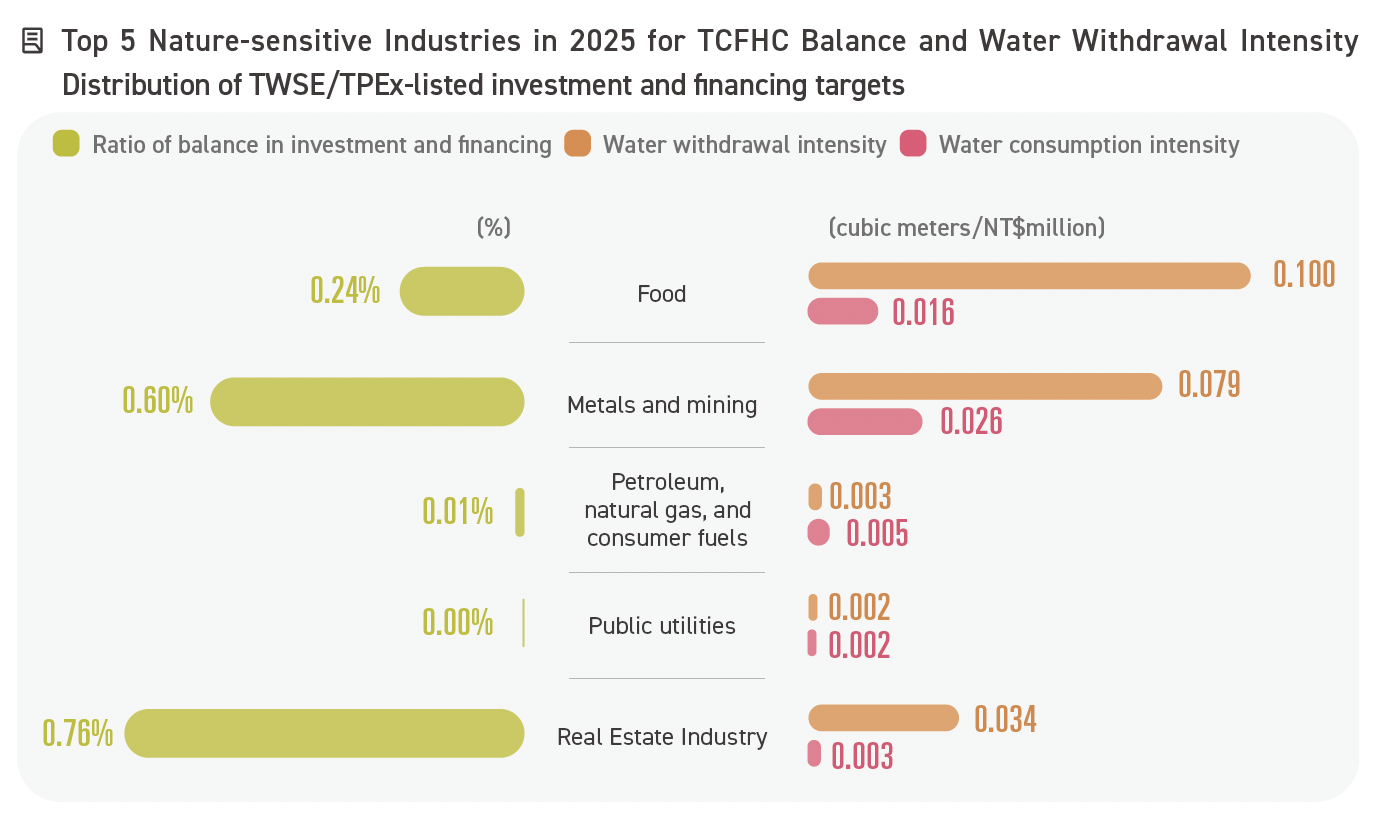
Based on the TNFD framework, for the dependency on natural capital and risks borne by investment and financing targets, "water withdrawal intensity", "water consumption intensity", and "water management policy" are selected to be water resource metrics and accordingly TWSE/TPEx-listed investment and financing targets are evaluated for their risk exposure to water resources. The current analysis focuses on industries with relatively high nature dependencies and impacts, including food, metals, and mining, petroleum & natural gas as well as consumer fuels, electricity utilities, and real estate.
Water Withdrawal Intensity and Water Consumption Intensity
Respective industries vary in their usage of the water resource. Food, metals, and mining, in particular, demonstrate higher intensities in both than other industries during the current analysis, indicating that their dependency on water resources is higher than the other industries included in the current analysis. Petroleum, natural gas, consumer fuels, electricity utilities, and real estate, on the other hand, score relatively low in water withdrawal and consumption intensities. Generally speaking, water resources intensities among TWSE/TPEx-listed investment and financing targets of the Group are moderate to low; the risk exposure remains controllable.
Risk management measures
